Showing posts with label Movies. Show all posts
Showing posts with label Movies. Show all posts
Friday, February 18, 2011


Friday, January 14, 2011
More on True Grit
I recently wrote about the move True Grit and some themes the movie touched on about the rule of law. Other legal commentators have been doing the same. Here's a round-up:
- Jeremy Telman on contract issues;
- Colin Miller on evidence issues;
- Isabel Archer on federalism and other issues; and
- Ilya Somin on law and economics issues.
Wednesday, January 12, 2011
True Grit, Orestia, and the Rule of Law
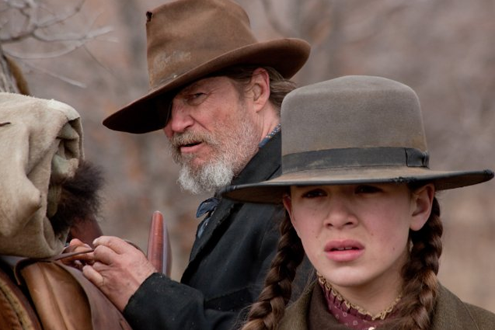
 The number-one movie in America last week was True Grit, a movie starring Jeff Bridges and Matt Damon that is a remake of the 1969 John Wayne classic. The plot of the movie is simple: a 14-year-old girl, Mattie Ross (played by Hailee Steinfeld) sets out to find Tom Chaney (played by Josh Brolin), her father's killer. Ross enlists the help of Rooster Cogburn (Bridges) a hard-drinking U.S. Marshal, and La Boeuf (Damon), a Texas Ranger. The story follows the Ross, Cogburn, and La Boeuf as they chase Chaney through Choctaw Indian country. On one level, the story is straightforward, telling the age-old story of a family member's quest for revenge. But the movie also contains important themes about the rule of law, themes that are almost as old as the familiar revenge story.
[Spoiler alert: plot details follow!]
But first, a digression, to a time long before the Wild West: in the Orestia Trilogy, Aeschylus tells the story of the House of Atreus and the curse that had befallen that family. The trilogy begins when Agamemnon is returning from the Trojan War. Clytemnestra, Agamemnon's wife, is planning to murder him upon his return, because Agamemnon had sacrificed their daughter so that the ships could sail at the start of the war. To exact revenge, Clytemnestra kills Agamemnon (and Cassandra, Agamemnon's war-prize) and takes up with her lover Aegisthus. In the second part of the trilogy, Orestes, Agamemnon's son, plans to avenge his father's death. He arrives at the palace, kills Aegisthus and (after some soul-searching), kills his mother as well.

But the saga is not over for Orestes. He has, by "the rules", done exactly what is supposed to in avenging his father's death-- but doing so required him to kill his own mother. The Furies torment Orestes and he is unable to find solace. Finally, Orestes appeals to Athena. Athena convenes a jury (eleven Athenians plus the goddess) and hears Orestes's case. Ultimately, the jury is split 6-6 and Orestes is acquitted.
The Orestia trilogy is generally thought of as symbolizing the transition from primitive self-help justice to the rule of law. For generations, the House of Atreus was cursed because each person sought to avenge a prior wrong by murdering the offender (Orestes killed Clytemnestra who killed Agamemnon who killed his daughter Iphignia, etc.). The gruesome chain only comes to an end when Orestes is subject, not to death, but to trial by jury.
And so back to True Grit. Mattie's quest initially seems analogous to that of Orestes: "You killed my father so I seek revenge." But it isn't that simple. Throughout the movie, it is clear that Mattie is well-versed in the law. (In negotiating a deal for some horses, she threatens to seek a "writ of replevin". Probably 95% of the audience had no idea what she meant.) She has a keen sense for the binding power of contracts -- she repeatedly tells Cogburn that he has to help her, because they have an agreement -- and fundamentally, she wants Chaney to stand trial for killing her father. Mattie asks why no one is searching for Chaney, and she is told that the crime is relatively minor so the government won't devote resources to a manhunt. But Mattie's manhunt is initially intended to bring Chaney to justice, not to simply kill him.
[again: spoiler alert!]
But that is ultimately what happens. In the movie's climax, Mattie shoots Chaney, sending him over a cliff to his death. In an earlier scene, she had shot at Chaney but not killed him; when she tried, her gun misfired. The point is, despite Mattie's general fidelity to the law, she had no compunctions about shooting and killing Chaney.
 We don't know what Chaney's family thinks of this. Perhaps they planned to get at Mattie but just failed. (The movie's epilogue shows her as an adult, so presumably she survived at least for a few more decades.) We also don't know how Mattie could have brought Chaney "to justice"; carrying him through Choctaw territory back to town was probably prohibitively difficult. To me, the most interesting thing was that Mattie, who seemed like she did not intend take the law into her own hands (though she was willing to take on responsibility for the manhunt) ultimately had no problem doing so.
A few thousand years ago, Aeschylus wrestled with the same themes. The rule of law, he taught, can bring an end to generations of vengeance, as society gives a single, final verdict as to the propriety of one's actions. But outside the bounds of that society, as Mattie Ross learned, one sometimes has no choice but to take matters into her own hands.
[True Grit images copyright Paramount Pictures. "The Murder of Agamemnon" by Pierre-Narcisse Guérin (ca. 1815).]
* * *
And now something totally unrelated: I've been on a bit of a blogging hiatus recently, but I do hope to pick up the pace in the coming weeks. Sorry for the absence!
Wednesday, January 5, 2011

Subscribe to:
Posts (Atom)
